IAPAR

Categories
2018 Day 3

Goshtichi Goshta and OoPicassoO

What is it? A Tree? A Fish? No, A Tree in a Fish. Oh fish! A Hen it is! The Third day of IAPAR 2K18 had Performances for children which commenced with Platform Performance of Goshtichi Goshta by Tiny Tales which received tremendous response by audience followed by the First International Performance of the festival OOPICASSOO, Directed by Julia Dina HeBe which depicted the innumerable possibilities one can find to express oneself. Breaking the conventional form of theatre, watching OOPICASSOO makes you feel completely out of School. When you are given a white canvas and colours like Blue, Yellow and Red you have infinite possibilities of making
anything out of it, You have a chance to discover, to evolve. If you draw a picture of a Dog and if it’s not your dog, like the dog of your imagination, than it doesn’t express you. It is about finding your way of expressing, developing your own language. It was about Creating your own creation no matter if it’s Meaningful or Meaningless. It was about Painting without borders. Probably this is why Pablo Picasso once said I want to paint like a child.

– Anushka Sarkate

Categories
2018 Day 3

Natya Vachan Spardha

Second day of Natya vachan spardha turned out to be a shift to family stories. We can safely say that caste, family and religion were the highlights of the day. ‘Dhadpad’ (ILS college) was performed first followed by ‘Dusra Samna’ (Aakar, Pune) and ‘Kurban’ (ILS college). One more thing that stood out today was – atmospheric sound. ‘Dhadpad’ and ‘Kurban’ focused on atmosphere too along with text. There were animal sound, songs, dholki and many more noise details created through voice, just so we can reach close to the story.’Dhadpad’, a play taking place in rural Maharashtra showed horrific effects of forced marriages we (sadly) still tolerate in our society. It also showed biased face of the society. How adults ‘contribute’ in every decision younger generation tries to make, even something as important as marriage.

‘Dusra Samna’ dealt with politics, caste and love. Just like the first one, in here too, we saw how parents tries to take control over children’s life. ‘Dusra Samna’ also brought dirty politics, bribe and centralized power into the picture. Small town politics was not far away from the real picture we see. Even the story took place in rural setting, the issue it brought was quiet contemporary and relevant to everyone.

Third play, ‘Kurban’, again a family story focused more on religion. It’s a story of small muslim family and terrible consequences they face just because of their religion. We hear these stories everywhere. Innocent people get killed each day and maybe that’s why we’ve become numb towards it. ‘Kurban’ showed a muslim moholla getting attacked because of religion riots and how family tries to survive it by sailing away through sea.

– Sanket Bagul

Categories
2018 Day 3

Acting Workshop – Ram Gopal Bajaj (INDIA)

The masterclass by Prof. Bajaj was facilitated over two days. Prof. Bajaj explained to the students how nature helps one become a good actor; animals use more vowels to convey their emotions. He talked about our senses and how they work together to react; how eyes, just by looking at some material, can tell if it is hard or smooth. It is all about making the senses strong. When any sensory organ senses something, one must observe how other sensory organs react to that. While talking about the purification of emotions, he shared that a good actor is like arampuri chaku – within a second, they can change their emotions. To make this happen, “Apko kisi ped ki dali tuti tobhi dukh hona chahiye,” he said. He conducted some exercises about contraction and expansion of the body, changing the leading point of the body, and shifting of emotions.

-Sushrut Mulavekar

Categories
2019 Day 6

Women of Ciudad Juarez by Teatro Travieso/Troublemaker Theatre (USA)

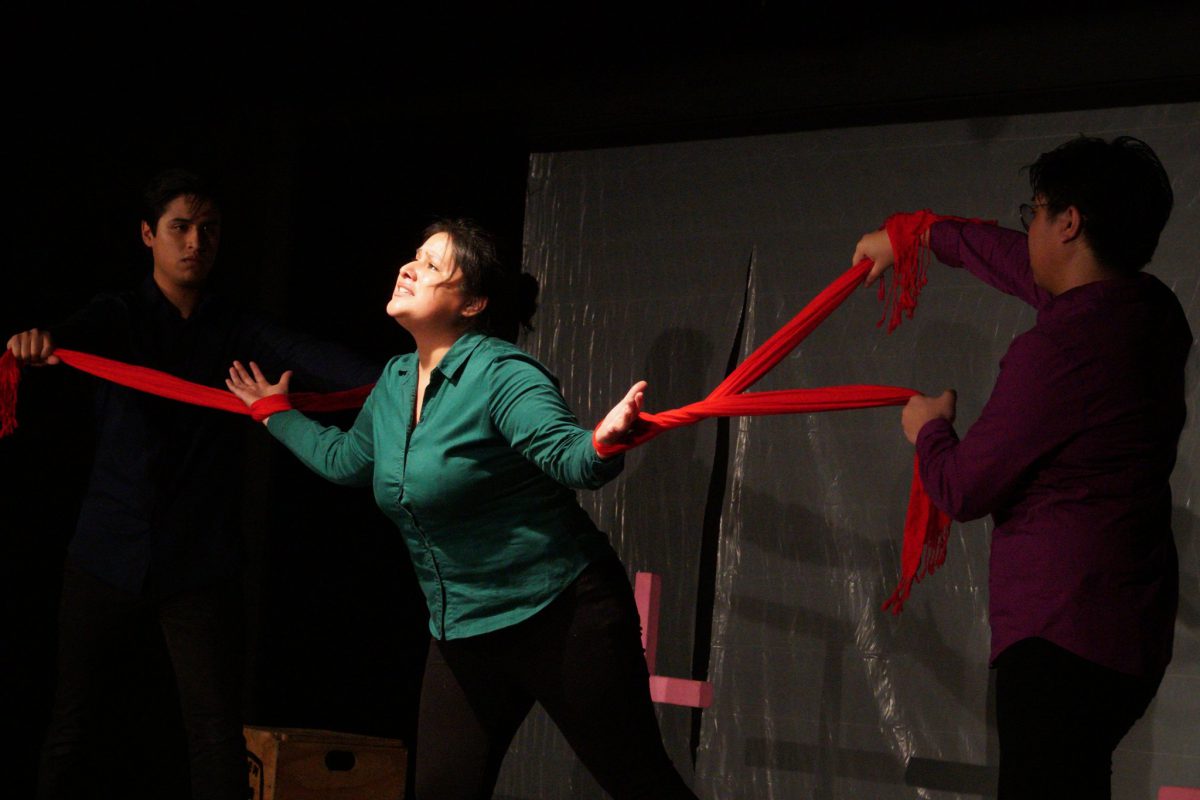
The performance, based on ethnographic interviews, told the heartbreaking story of Juarez, Mexico where hundreds of young girls and women have been raped, murdered, and tortured in 1993. It spoke of femicide in the city through three actors changing roles from women, their family members, and investigating officers. Light and shadow play, grim set objects (such as Christian Crosses signifying graves), modernly dressed actors, and excruciatingly painful and direct dialogue with the audience made the performance overwhelming and shook the audience. It invoked feelings of helpless anger, desperate questioning, and disbelief at the level of cruelty some human beings can inflict upon other human beings. 

Categories
2019 Day 5

Miss Mertens Refuses to Grow Bigger by Carolin Sanders (Germany)

Miss Mertens was a performance that talked about sustainability. It started with a new and unique setting. The whole performance area was set in a very casual method. The snacks and the distance with the actors was a completely new experience or the audience in Pune. The fifteen minutes long performance explained the inner exploration of the actor. It made use of very little set and casual costumes which is what made connecting to the character much easier. All in all, the performance was an exceptional story of self andsustainability of the environment, and the problems faced by this particular character.

Categories
2019 Day 5

Pirosmani by Poti Valerian Gunia Professional State Theatre (Georgia)

One of the many legends about Niko Pirosmani was depicted through storytelling in this wonderful puppetry performance. White lighting, black costumes of the actors, and the perfectly handled puppets made magic on stage. The actors were emotionally one with the puppet and they together depicted a story with minimal words. The movements of the puppets were so detailed and delicate that they started seeming alive at one point. The synchronization and attention to detail were on point which made the audience not want to even blink an eye.

Categories
2019 Day 5

The Physical Text Workshop by Dr. Jimmy Noriega (USA)

The session by Dr. Jimmy Noriega started with basic warm-up walks. The workshop aimed at bringing into an actor’s performance different types of walks and developing basic group dynamics. Movement in group dynamics is developed due to this exercise. The next part concentrated on the various elements of art and performance and how these elements affect movement and meaning-making in a performance.